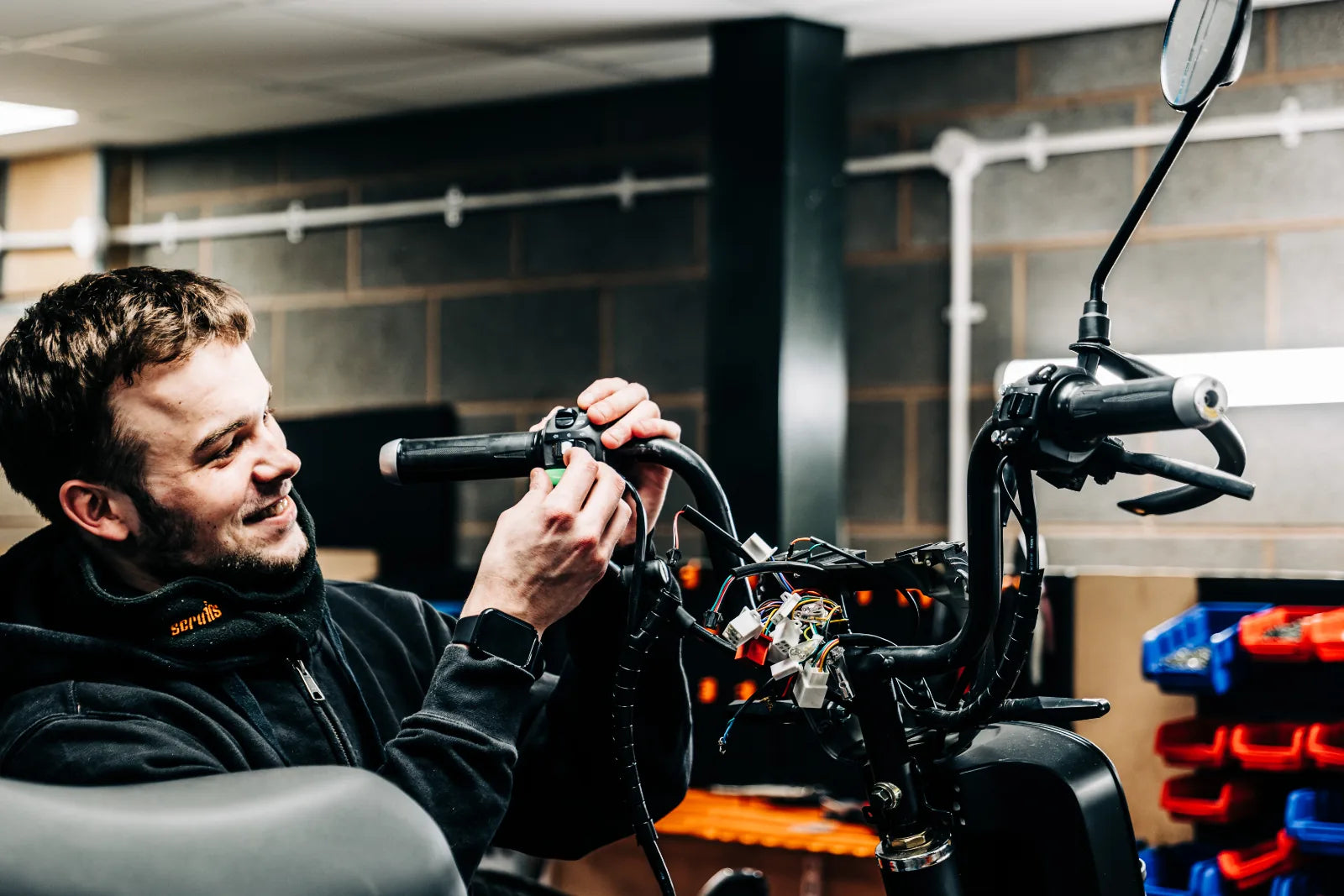
The smarter way to
deliver.
An electric bike isn't a perfect product. But it is significantly better for the environment than the alternatives — and you deserve the real data, not marketing spin.
How Every km
Compares.
Full lifecycle emissions — including manufacturing, fuel or electricity production, and end-of-life. Not just the tailpipe.
Source: European Cyclists' Federation lifecycle analysis (Ecoinvent database); UK DfT well-to-wheel figures; Our World in Data. Figures per passenger-km.
Zero at the Point
That Matters Most.
CO₂ is a global problem. NOx and particulates are a local one — they harm people within metres of the vehicle. On both counts, electric beats petrol.
Zero NOx
Nitrogen oxides cause respiratory disease and are a primary component of urban smog. Eskuta produces zero at point of use.
Zero PM2.5 & PM10
Fine particulates penetrate deep into lung tissue and are linked to cardiovascular and respiratory deaths. Zero from an electric motor.
Zero hydrocarbons
Two-stroke petrol mopeds emit up to 30× more hydrocarbons than car standards allow. Electric motors produce none whatsoever.
ULEZ exempt — permanently
EAPCs are exempt from London's ULEZ, Birmingham's CAZ, Bath's CAZ, and every other clean air scheme in the UK — now and in future. No charge, no annual review.
100% EAPC-Compliant.
No Licence Required.
"A non-compliant moped in London costs £3,250 in ULEZ charges per year for a delivery rider riding 5 days a week. Every Eskuta pays £0 — now and permanently."
40× Less to Build.
Paid Back in 620 Miles.
Every vehicle has a manufacturing carbon cost. The question is how quickly using it pays that back — and how it compares to the alternatives.
40× less CO₂ to manufacture
Building an e-bike produces ~150 kg CO₂e. Building the average new car produces ~6,000 kg CO₂e — 40 times more — before it has moved a single metre.
Paid back in under 1,000 km
An e-bike pays back its entire manufacturing carbon footprint — compared to driving a petrol car — in under 1,000 km. At a 10 km daily commute each way, that is under two months.
Steel, not aluminium — deliberately
Steel produces ~1.9 kg CO₂e per kg. Primary aluminium produces ~18 kg CO₂e per kg — roughly 9× more. Eskuta uses electroplated steel: heavier, but far lower manufacturing carbon.
Built to last, not to be replaced
A durable bike lasting 10 years produces far less lifecycle carbon than a lightweight bike replaced every 3 years. CBS brakes, reinforced tyres, and steel construction are sustainability decisions as much as engineering ones.
What Happens to the Battery.
The battery is the most environmentally sensitive part of any electric vehicle. Here is what we know, what the regulations require, and the honest answers.
Lifespan: 3–8 years
Most quality lithium-ion e-bike batteries last 500–1,500 charge cycles. One charge per day means 3–5 years for a heavy delivery rider, 5–8 years for a commuter. After ~80% capacity, the battery is ready for second-life applications.
End of life: legally regulated
Under UK Waste Batteries and Accumulators Regulations, producers must ensure batteries go to an Approved Battery Treatment Operator — not landfill. Eskuta batteries can be dropped off at council Household Reuse and Recycling Centres (HWRCs) nationwide under UK WEEE regulations.
Second life: energy storage
Batteries retaining 75–80% capacity at the end of e-bike life are suitable for stationary energy storage — paired with solar panels or grid-balancing applications. Research in Nature Communications (2024) found reusing 40% of batteries could cover the EU's entire stationary storage need by 2040.
The honest answer on lithium mining
100% EAPC-Compliant.
No Licence Required.
"Lithium extraction and cobalt mining have real environmental and human rights concerns — and we think dismissing them would be dishonest. Context: an e-bike battery is 0.3–0.7 kWh. An EV battery is 40–100 kWh. The mining impact per vehicle is proportionally far smaller. Modern LFP chemistries contain no cobalt at all. And the manufacturing carbon is paid back in under 1,000 km of replacing petrol trips."

Your Bike Gets Cleaner Every Year.
The UK grid's carbon intensity fell 70% in a decade — from 419 gCO₂/kWh in 2014 to 124 gCO₂/kWh in 2024. The UK closed its last coal power station in September 2024 — the first major economy to do so.
Because approximately 10% of an e-bike's lifetime carbon comes from the electricity it uses, a cleaner grid means a cleaner bike automatically, with no modification to the vehicle. Government targets aim for approximately 50 gCO₂/kWh by 2030.
No other vehicle technology gets cleaner over time without changes to the vehicle itself. A petrol moped bought today will always burn petrol. An Eskuta bought today will run on an increasingly renewable grid for its entire life.
What Happens When People Switch.
One bike makes a difference. The aggregate impact of switching — at scale — is substantial.
68%
of UK car trips are under 5 miles — well within e-bike range on a single charge. Most of what people use cars for daily, an Eskuta can replace.
12%
reduction in urban car CO₂ if 15% of car trips were made by e-bike instead. Individual action at scale becomes systemic change.
~1p/mile
in electricity to run an Eskuta — versus approximately 7p per mile for a petrol moped. The savings compound significantly over years of use.
£6bn/yr
annual health damage from car and van air pollution to the NHS and wider UK society. Riding an Eskuta removes your contribution from that number.
Frequently asked questions.
We think you deserve straight answers, not marketing copy.
-
Yes, significantly. On a full lifecycle basis — including manufacturing and electricity generation — an electric bike produces approximately 15 grams of CO₂ per kilometre. A petrol 50cc moped produces approximately 83 grams per kilometre on a well-to-wheel basis. That is roughly 5–6 times more CO₂ per km.
-
Under UK Waste Batteries and Accumulators Regulations, producers are legally required to ensure batteries go to an Approved Battery Treatment Operator — not landfill. Eskuta batteries can also be dropped off at council Household Reuse and Recycling Centres (HWRCs) nationwide. Batteries that retain 75–80% of their original capacity are suitable for second-life stationary energy storage applications.
-
Lithium extraction does have environmental impacts — particularly water use in the Atacama desert. However, an e-bike battery is typically 0.3–0.7 kWh compared to 40–100 kWh for an EV. The mining impact per vehicle is proportionally far smaller. Modern LFP chemistries increasingly contain no cobalt at all. And the manufacturing carbon is paid back in under 1,000 km of replacing petrol vehicle trips.
-
Yes. The UK grid's carbon intensity fell by 70% between 2014 and 2024 — from 419 gCO₂/kWh to 124 gCO₂/kWh. With government targets aiming for approximately 50 gCO₂/kWh by 2030, a bike bought today will generate less and less operational carbon every year without any change to the bike itself.
Make the switch
The future of mobility
is already here.
Zero tailpipe emissions. ULEZ exempt. 40 times less CO₂ to build than a car. The case for switching to an Eskuta is environmental, financial, and practical.